
financing
What does it mean to be upside down on a car loan?
The short answer
Being upside down, or underwater, means you owe more on your loan than the car is currently worth, so selling or trading it would not cover the payoff. It happens fastest with little or no down payment, long loan terms, and higher rates, since more of each early payment goes to interest instead of principal. Used loans compound this, averaging 11.43% in Q1 2026, which slows how fast you build real equity.
Assumes: United States market · Worked example uses the Q1 2026 average used loan of $27,070 at 11.43% APR over an assumed 60 month term · Assumes a standard amortizing loan with no fees rolled in
The definition, plainly
Being upside down, or underwater, on a car loan means you owe more than the car is currently worth. If you sold it or traded it in today, the payoff would exceed what a buyer or dealer would actually pay, and you would need to cover the difference in cash to walk away clean.
How it happens
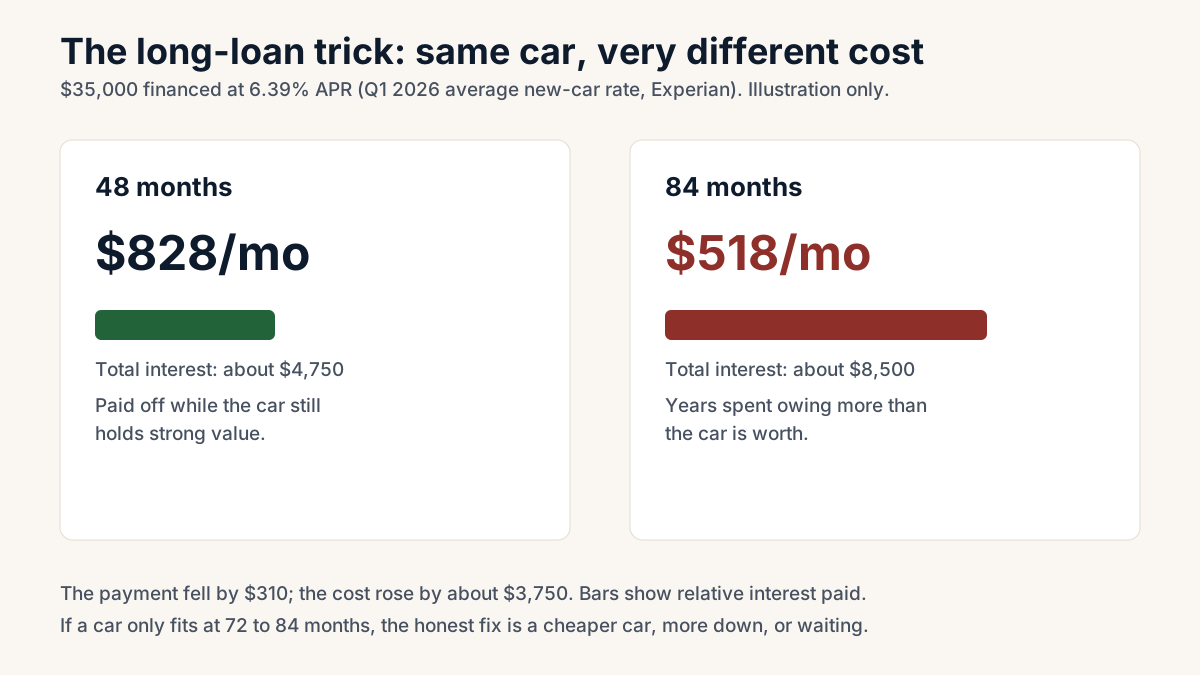
It happens fastest with little or no down payment, since the loan starts at or near the car’s full price with no cushion built in. Long loan terms make it worse, because the balance falls slowly while the car’s value falls quickly in the early years. Higher interest rates compound the problem, since more of each early payment goes to interest instead of principal, meaning the balance barely moves for a while even though you are paying every month. Rolling negative equity forward from a previous trade-in stacks a fourth factor on top of the other three.
The math that works against you early on
Take the Q1 2026 average used loan of $27,070 at the average used APR of 11.43%, over an assumed 60 month term. That works out to a payment of roughly $594 a month, illustrative math, not a quote. In the first month alone, about $258 of that payment is pure interest, and only about $337 actually reduces what you owe.
| Estimated monthly payment | ≈ $594 |
|---|---|
| Estimated interest portion, month one | ≈ $258 |
| Estimated principal portion, month one | ≈ $337 |
Your balance barely moves relative to the payment you just made, while the car itself is already depreciating in the background. That ratio improves every month as the balance shrinks, but early on, a meaningful share of every payment is not building equity, it is covering the cost of the loan itself.
None of this is unique to any one lender or vehicle, it is simple arithmetic that applies to every amortizing loan, which is exactly why it is worth understanding rather than treating as bad luck when it shows up.
Why used loans are especially exposed
Used loans compound this problem twice over. The average used APR ran 11.43% in Q1 2026, well above a typical new-car rate, which slows principal paydown in exactly the way shown above. At the same time, a used car’s remaining depreciation curve is less predictable than a new car’s more documented one, so the value side of the equation is harder to track with confidence.
Is being upside down always a disaster?
No. It is only a problem the moment you need the loan balance and the car’s value to line up, selling, trading, or a total-loss insurance claim. If you plan to keep driving the car and keep making payments as agreed, being temporarily upside down costs you nothing beyond the interest you were already paying. It becomes expensive specifically when it collides with a decision to sell or trade, or when the car is totaled and insurance pays actual cash value instead of your full payoff.
It does not affect your ability to keep driving
Being upside down changes nothing about your right to keep the car and keep paying as agreed, a lender does not call a loan due just because the balance temporarily exceeds the car’s value. The risk is specific to moments when you need those two numbers to match, not a constant, ongoing problem with a loan that is otherwise being paid on time.
What actually forces the issue
The two most common triggers are needing to sell or trade before the gap closes on its own, often because of a job change, a growing family, or simply wanting something different, and a total loss, an accident or theft that ends the loan on the insurance company’s schedule rather than yours. Neither is fully avoidable in every situation, which is part of why understanding the risk before you finance matters more than trying to time your way around it after the fact.
Getting back above water
Extra principal payments, even irregular ones, shrink the gap directly since they come off the balance rather than future interest. Simply keeping the car and continuing to pay closes the gap over time, as the balance eventually falls faster than the car’s remaining depreciation. A larger voluntary payment toward principal is the fastest lever if you have the cash and no better use for it, like paying down higher-rate debt elsewhere first. Confirm with your lender that extra payments apply directly to principal rather than simply prepaying future scheduled payments, the wording in a loan servicing account can differ from what you would assume.
A quick gut check on your own loan
Look up your current payoff balance and compare it honestly against what similar vehicles in your car’s actual condition and mileage are really selling for, not what you paid or what you hope it is worth. If the payoff is higher, you now have a real number, the actual size of the gap, instead of a vague worry. That number is what decides whether this matters for your situation right now, or whether it is just background math that resolves itself the longer you keep paying.
Next steps
Get your current loan balance and an honest estimate of your car’s value to see where you actually stand. If you are upside down and need to trade the car in anyway, know the shortfall before you visit a dealer, not after. If you are financing a new car next, a bigger down payment and a shorter loan term are the two levers most within your control to avoid repeating this.
Sources
- Average new-car payment was $770/month in Q1 2026
- Average used-car loan APR was about 11.43% in Q1 2026
Facts on this page were last verified on .
Independent publication: this site is not affiliated with, sponsored by, or endorsed by Honda or any manufacturer or dealership. Content is educational, not mechanical, legal, or financial advice. Verify safety-critical items with a qualified technician and recall status by VIN.